

Hey there! As a supplier of Jump Starter Air Pumps, I often get asked one question more than anything else: "How long does it take to inflate a tire with a Jump Starter Air Pump?" Well, let's dive right into it and break it down for you.
First off, it's important to understand that the time it takes to inflate a tire isn't a one - size - fits - all answer. There are several factors that come into play, and we'll go through each of them one by one.
Factors Affecting Inflation Time
Tire Size
This is a no - brainer. Bigger tires require more air to reach the proper pressure. A compact car tire is going to take less time to inflate compared to a large SUV or truck tire. For instance, a standard passenger car tire might have a volume of around 10 - 15 liters, while a large truck tire can have a volume upwards of 50 liters. So, if you're using the same Jump Starter Air Pump, the truck tire is going to take significantly longer to inflate.
Starting Pressure
The current pressure in the tire also matters a great deal. If your tire is only slightly under - inflated, say it's at 25 psi when it should be at 32 psi, it'll take less time to top it off than if the tire is completely flat, at 0 psi. The pump has to work harder and for a longer period to fill a completely empty tire to the desired pressure.
Pump Capacity
Not all Jump Starter Air Pumps are created equal. Some pumps have a higher flow rate, which means they can push more air into the tire per minute. A pump with a high - capacity motor and a well - designed air delivery system will inflate a tire faster than a lower - capacity one. When you're shopping for a Jump Starter Air Pump, look for the specifications that mention the flow rate, usually measured in liters per minute (LPM) or cubic feet per minute (CFM).
Desired Pressure
The pressure you want to reach in the tire is another crucial factor. If you're just looking to get the tire to a basic driving pressure, it'll take less time than if you're aiming for a very specific, high - pressure setting, like what some performance vehicles require.
Calculating Inflation Time
Now, let's talk about how you can estimate the inflation time. While it's not an exact science, we can use some general guidelines.
Let's assume we have a Jump Starter Air Pump with a flow rate of 30 LPM. If we're inflating a small car tire with a volume of 12 liters and it's currently at 20 psi, and we want to get it to 32 psi. First, we need to calculate the amount of air needed to reach the desired pressure.
The ideal gas law (PV = nRT) can give us a rough idea, but for simplicity's sake, we can use some empirical data. For every 1 psi increase in a 12 - liter tire, we need approximately 0.5 liters of air. So, to go from 20 psi to 32 psi, we need to increase the pressure by 12 psi. That means we need about 12 * 0.5 = 6 liters of air.
With a pump flow rate of 30 LPM, we can calculate the time it'll take. Time = Volume / Flow Rate. So, 6 liters / 30 LPM = 0.2 minutes or 12 seconds.
However, this is a very simplified calculation. In real - world scenarios, there are losses due to friction in the air hose, the efficiency of the pump, and other factors. So, in practice, it might take a bit longer, say around 20 - 30 seconds.
Real - World Examples
Let's look at some real - world examples to give you a better sense of how long it can take to inflate different types of tires.
Compact Car Tires
For a compact car tire that's slightly under - inflated, say from 28 psi to 32 psi, a decent Jump Starter Air Pump can usually get the job done in about 30 - 60 seconds. If the tire is completely flat, it might take 2 - 3 minutes.
SUV Tires
SUV tires are larger, so they take longer. If you're topping off an under - inflated SUV tire, it could take 1 - 2 minutes. Inflating a flat SUV tire can take anywhere from 5 - 10 minutes.
Truck Tires
Truck tires are the big boys. Topping off a truck tire might take 2 - 3 minutes, and inflating a flat truck tire can take 10 - 15 minutes or even longer, depending on the size of the tire and the capacity of the pump.
Choosing the Right Jump Starter Air Pump
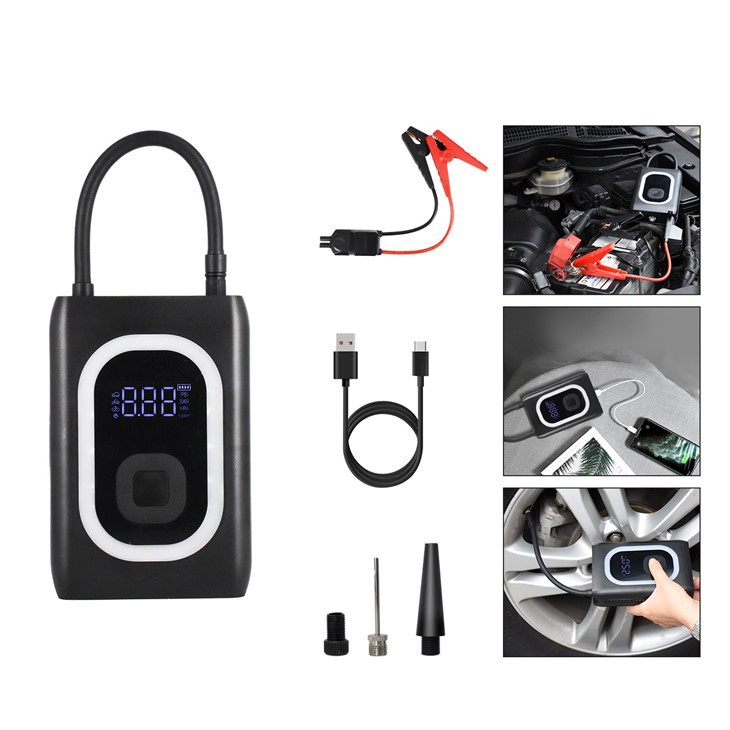
If you're in the market for a Jump Starter Air Pump, you want one that can get the job done quickly and efficiently. That's where our products come in. We offer a range of high - quality Jump Starter Air Pumps that are designed to inflate tires fast.
One of our top - selling products is the Best Portable Battery Operated Tire Inflator. It has a high - flow rate, a durable battery, and is very easy to use. Whether you're at home, on the road, or at a worksite, this pump will get your tires inflated in no time.
Tips for Faster Inflation
Here are some tips to help you inflate your tires faster:
- Keep the Pump Cool: Overheating can reduce the efficiency of the pump. If you're inflating multiple tires, give the pump a short break between each tire to cool down.
- Check the Air Hose: Make sure the air hose is not kinked or blocked. A blocked hose can restrict the airflow and slow down the inflation process.
- Use the Right Nozzle: Different tires may require different nozzles. Using the correct nozzle ensures a proper seal and efficient air transfer.
Conclusion
So, as you can see, the time it takes to inflate a tire with a Jump Starter Air Pump depends on a variety of factors. But with the right pump and a little know - how, you can get your tires inflated quickly and safely.
If you're interested in our Jump Starter Air Pumps and want to learn more about our products or are looking to make a purchase, don't hesitate to reach out. We're always here to answer your questions and help you find the perfect pump for your needs. Whether you're a DIY enthusiast, a professional mechanic, or just someone who wants to be prepared on the road, we've got you covered.
References
- Automotive Tire Handbook, Rubber Manufacturers Association
- Various product manuals of Jump Starter Air Pumps